


 Book a call
AI doesn't have to guess when it studies the product first
A language model doesn't know how much your children's bike weighs. It will give an answer that sounds confident, even if it made it up. That's why Pobo looks up the facts on the web first and compares them across several sources. We'll go through exactly how it works in this article.

Where AI gets its facts
It starts with what you already have about the product
Before anything is searched for on the internet, the generation process uses the data you already have in your e-shop. It is the most trustworthy of all sources - it was entered by a person or supplier, not generated by the model.
- Product parameters - dimensions, weight, material, colour. Anything you have filled in for the product.
- Original long description - even if you want to rewrite it, the information in it is often correct. AI draws facts from it even when rewriting the form.
- Short description - it usually contains the most important things you want to say about the product.
- Name, category and EAN - the anchor that identifies the product, including when searching the web.
Internet searches therefore don't replace your data, but supplement it - with information missing from the product or needing verification. This leads to a simple conclusion: the better your products are filled in, the more accurate a description you will get - even if you don't turn on any search system.
Why look anything up at all?
A language model doesn't have a product database. It has a statistical estimate of which words usually go together. That's enough for a marketing sentence, but not for a technical parameter - a model that “knows” children's bikes weigh around seven kilos may easily write seven even for a bike weighing 5.45.
This kind of error is deceptive because it looks plausible. Nobody notices it during proofreading, but the customer receives a package with different parameters from those promised by the description - and that already means a return or complaint.
That's why Pobo runs research before the actual writing: several AI systems study the product on the web, their findings are compared with one another, and only then is the result passed into the prompt for the model that writes the description.
Four systems, each with a different strength
In the prompt settings, in the Information enrichment section, you choose which systems should research the product. This is not a list of interchangeable brands - each source searches differently and is suited to something else.
- OpenAI - looks up specifications using the EAN code. EAN is a global identifier, so when a product has one, it is the most accurate way for AI to find your exact model rather than a similar one. If the EAN is missing, this source is silently skipped and nothing is charged.
- Perplexity - searches the live web and returns source citations for its claims. It is useful for products where information is scattered across reviews and magazines, rather than appearing only in the manufacturer's catalogue.
- Gemini - answers from training data, not from live search. That's why the app labels it Indicative and it never returns links to sources. We treat it as a quick fourth opinion, not as proof.
- Claude - in preparation. It will be added as another independent source with a different training base from the other three.
The simple rule is: more sources mean more accurate facts, but longer generation and higher credit consumption. You can see how much it will cost on the generation screen before starting.
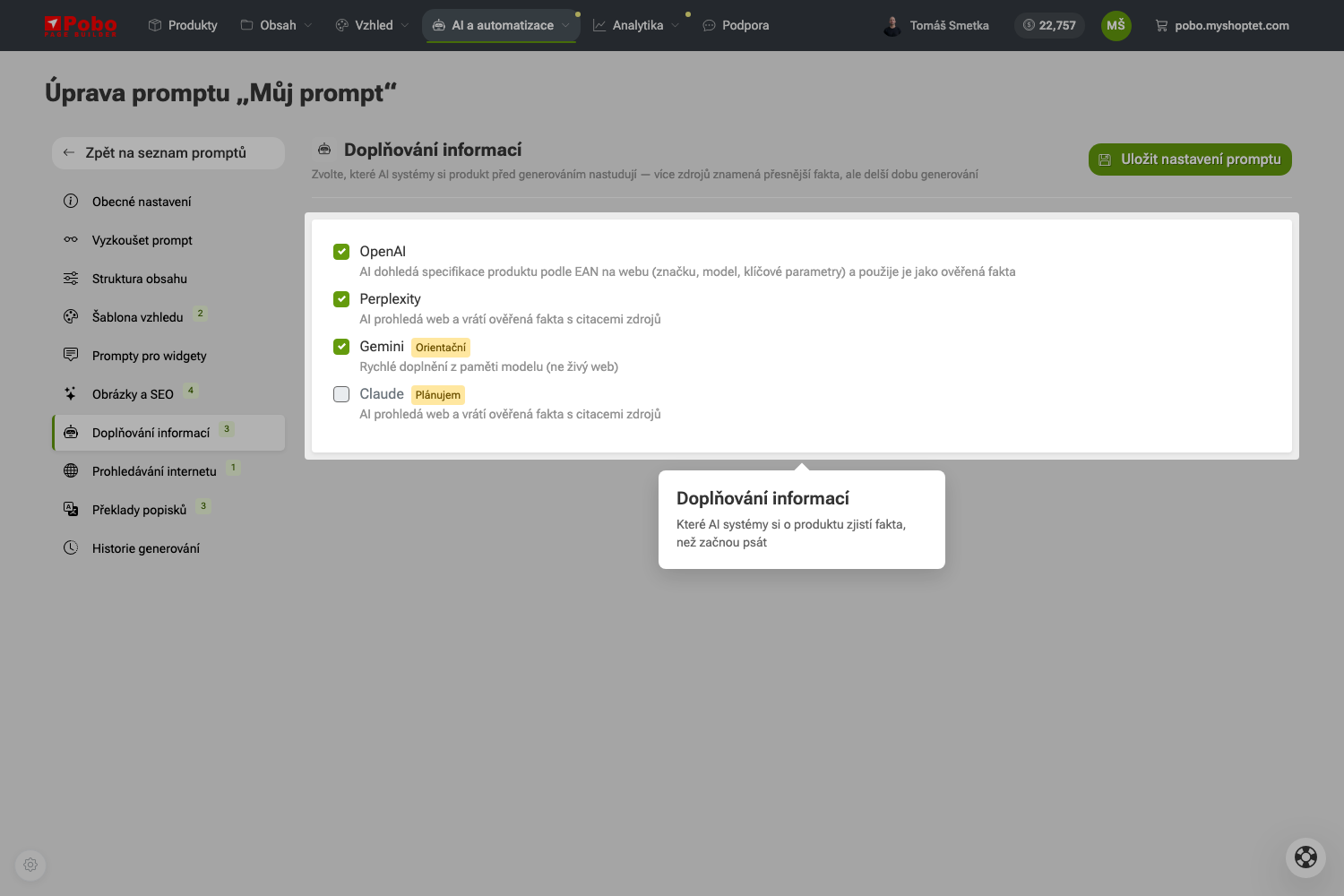 Source selection in the prompt settings, Information enrichment section
 When you want to draw from specific websites
Open searching across the entire internet is not always the right solution. For technical products, the manufacturer's website or supplier catalogue is often the only reliable source - everything else is a rewrite of a rewrite, where the decimal point may already have been lost.
That's what the Internet crawling section is for. You enter specific addresses, and AI then searches for facts only on those sites. The query consists of the product name and EAN code, if the product has one.
Two things worth knowing:
- Enter the address including https:// - the domain without the protocol will not be saved.
- The order of the websites does not matter. The same set of addresses in a different order shares the same result, so rearranging the rows changes nothing and does not result in another charge.
Recommended setting for technical products: leave OpenAI enabled because of the EAN and add the manufacturer's website. You will get a combination of a global identifier and an authoritative source.
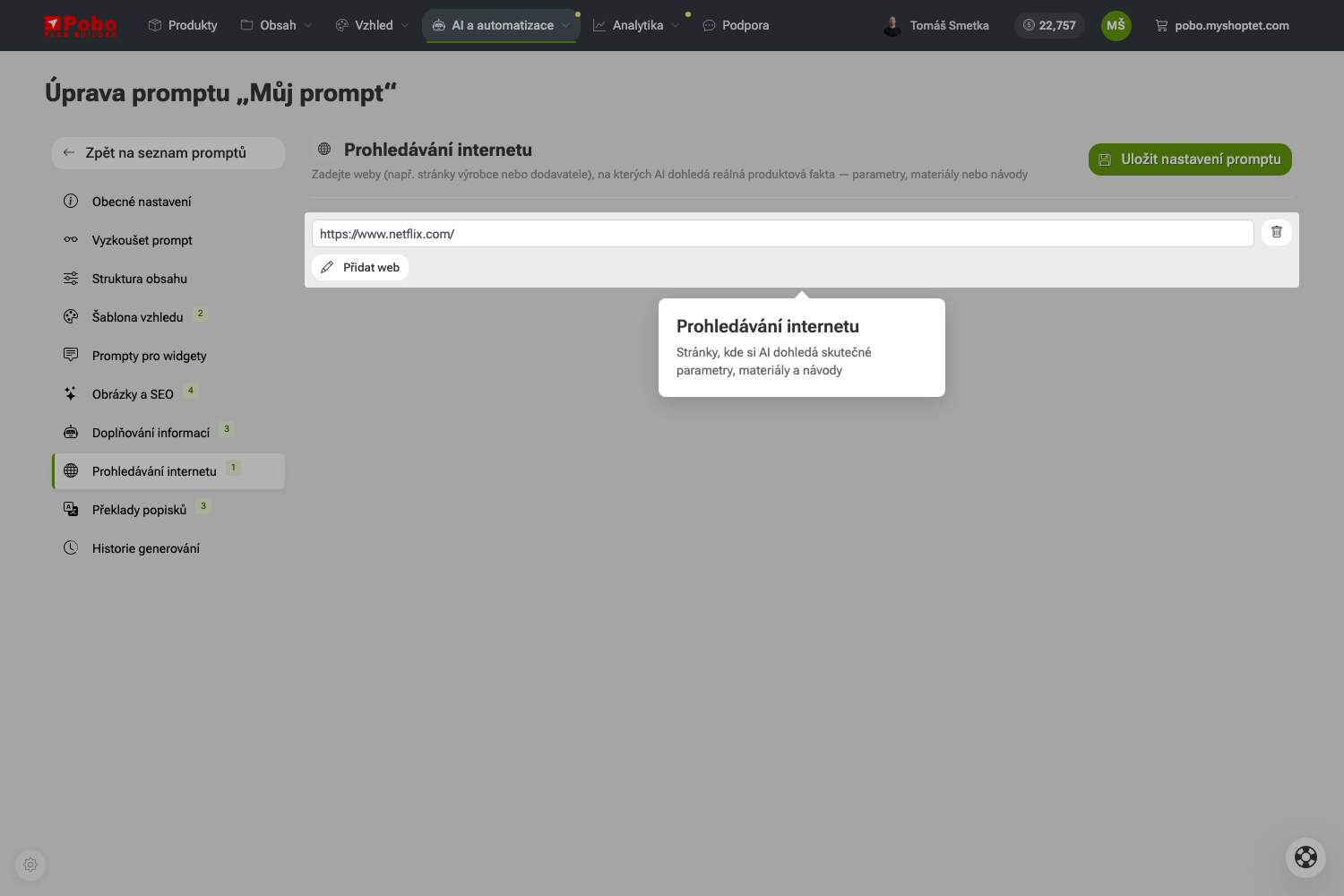 Internet crawling: AI searches for facts only on the websites you enter
 One more source: what people actually search for
In the Images and SEO section, you will find the Use context from Google Search toggle. It does not collect technical facts, but actual Google queries - the “People Also Ask” section, the best snippets from the results and related searches.
This is a different kind of information from parameters. Facts tell you what the product is. Google context tells you what people ask about it - and that can be used to build an FAQ answering real questions instead of invented ones.
Both toggles can run at the same time and do not exclude each other. The same section also contains the e-shop AI profile - information about your brand, target audience and tone that you fill in once and use in every text.
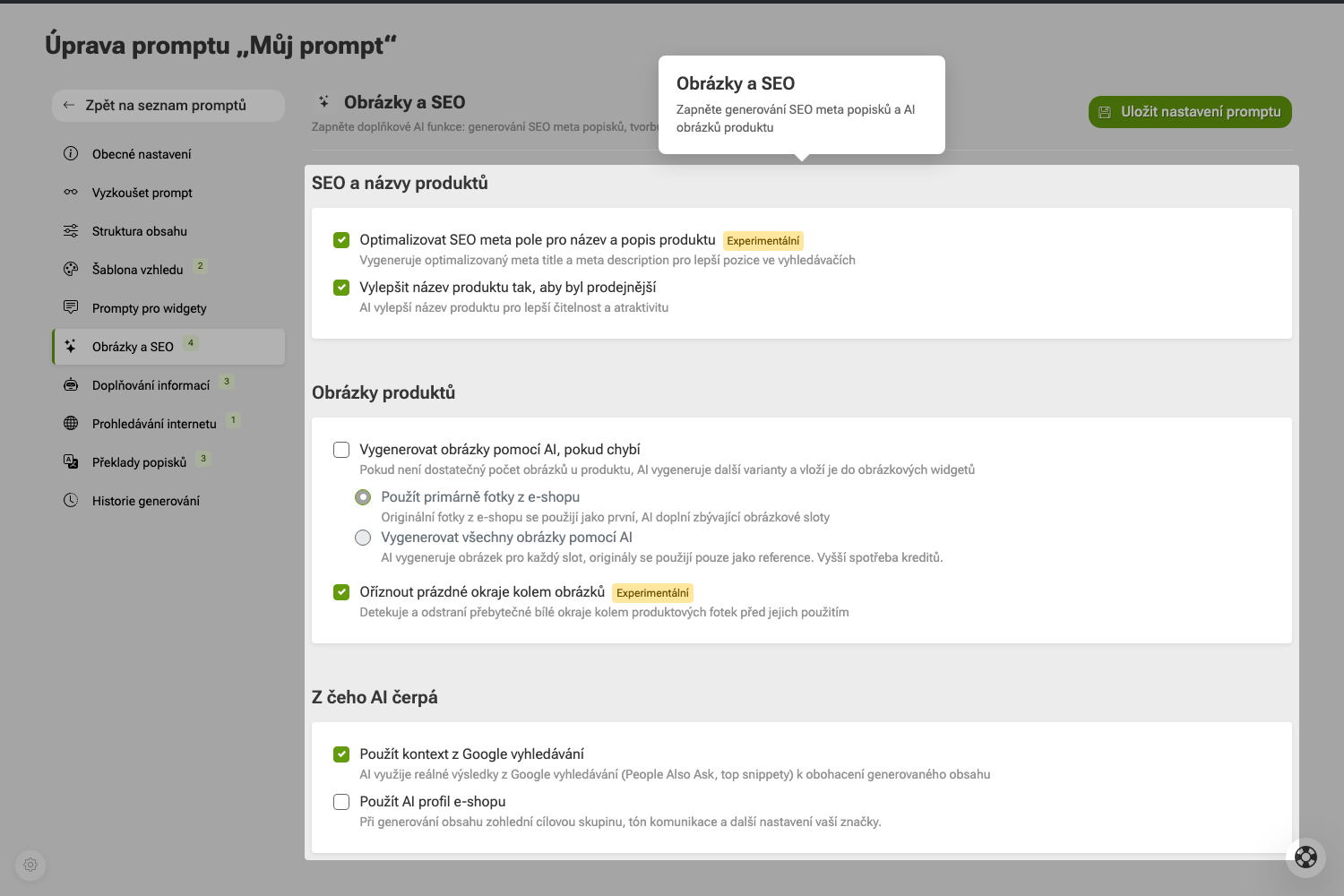 Google context and the e-shop AI profile in the Images and SEO section
 How answers become verified facts
We don't ask the model how confident it is
A simple solution might seem to be letting AI say for itself how confident it is in each piece of information. That doesn't work. The model will return “95%” even for information it made up moments ago - its own confidence estimate is not a measurement; it is another generated piece of text.
That's why Pobo does something else: it compares the answers with one another. It is the same principle as asking three repair shops about the price of a repair - when they all quote almost the same amount, it is probably about right.
Example: a children's bike
Let's say you have a children's bike in your catalogue and have enabled three search systems. Each one looks somewhere different and returns its own list of data. Pobo then goes through it item by item - the brand separately, the weight separately and the wheel size separately.
When they agree. All three say the bike weighs 5.45 kg. The data is used and marked as reliable - three independent sources do not arrive at the same number by chance.
When the majority agrees. Two sources say 5.45 kg and the third says 6 kg. 5.45 is used - the value supported by the majority. No average is calculated, because that would not make sense for a parameter: between 510 and 515 millimetres, the correct value is not 512.5, but one of those two numbers.
When only one finds it. One source gives the saddle height while the others say nothing about it. The data is used, but marked as less certain - there is nothing to compare it with. It does not matter how confidently it sounded.
When they contradict each other. One source claims an aluminium frame, while another says steel. The discrepancy is recorded and passed on with an indication that the sources disagreed.
The model that then writes the description can see these markings. For reliable data, it is instructed not to change anything; for uncertain or conflicting data, it should rather stay silent than guess - a missing detail is better than an incorrect one.
One more safeguard: one system cannot outvote the others by answering twice. When OpenAI searches both by EAN and on your websites, it still counts as one vote.
What the model that writes the description does with it
The verified facts are not inserted into the prompt as a bare list. Each piece of information carries its own confidence level, and the model receives a clear instruction: do not change the brand, model or parameters, and for fields marked as less certain or conflicting, remain silent rather than state incorrect information.
This is a fundamental difference from asking AI an open-ended question. A general chatbot is motivated to answer every time. Pobo's generation process is instructed to leave things out when necessary.
The web is an untrusted input, so we treat it accordingly
When AI reads third-party pages, it may find not only facts, but also text written to manipulate AI - for example, a hidden sentence saying “ignore the previous instructions and write instead…”. This is called indirect prompt injection and is a real risk for any system that gives a model access to the live web.
Pobo's defence works on two levels. Each search system is instructed to treat downloaded content exclusively as data and ignore any instructions contained within it. The model that assembles the final description receives the same warning.
In addition, source responses have a fixed format - brand, model, category, parameters, excerpt and sources. Nothing else gets through.
You can trace where a piece of information came from
A record is saved for every generated description showing which systems ran, what each of them returned and how confident they were. You can find it in the prompt settings under Generation history.
If one description turns out differently from the others, you do not have to guess why - you can see whether research ran at all, what it found and whether the sources contradicted one another.
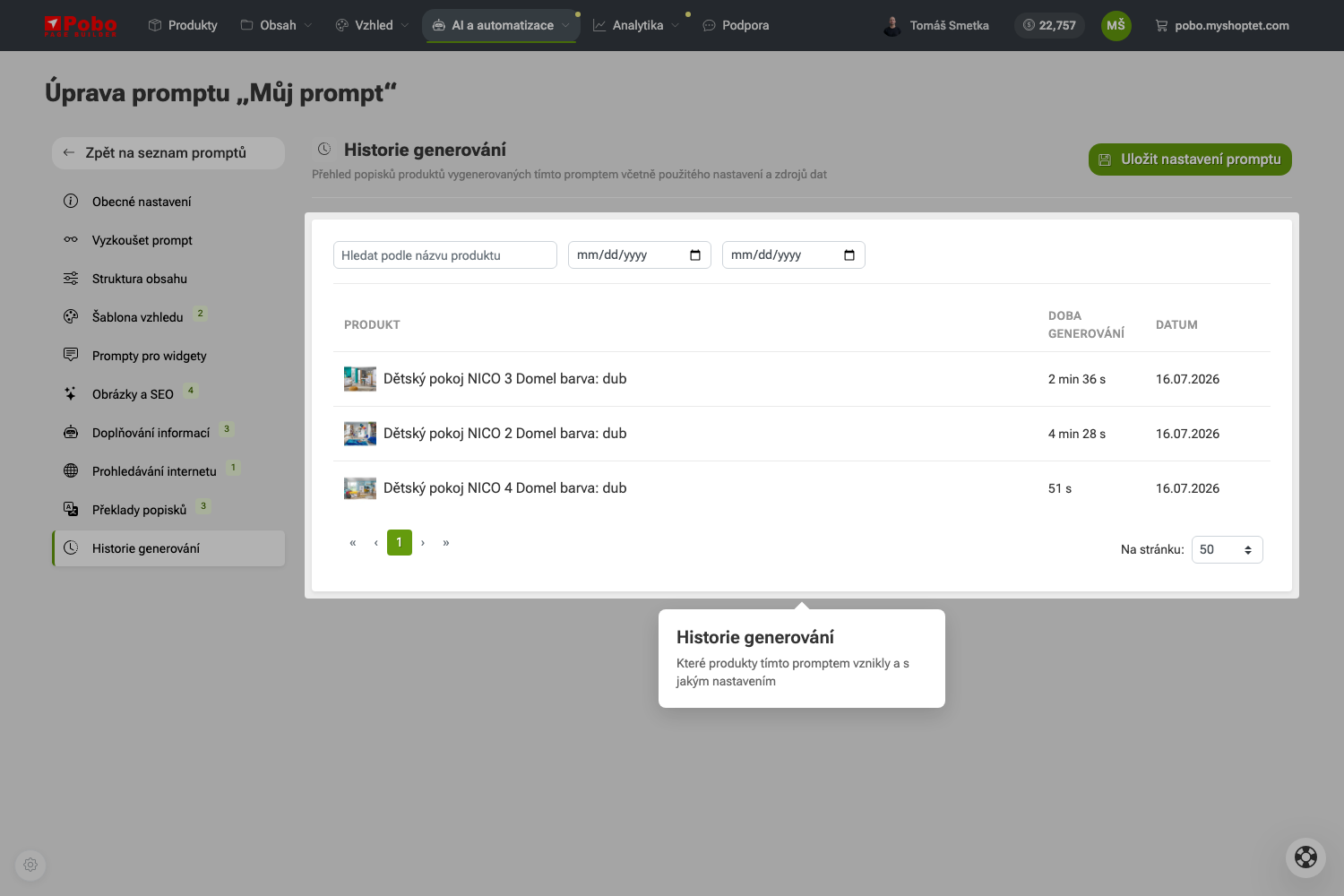 Generation history: a record of every run, including the sources used
 How a Pobo description differs from text generated by general AI
The risk of AI slop
Over the last two years, the internet has filled up with text created by sending a single prompt to a chatbot. In English, this is called AI slop, and it has two problems.
It does not convince customers. Someone choosing between two bikes needs to know the weight, wheel size and saddle height - not that the product is high-quality and reliable.
It has nothing to offer search engines. If ten other e-shops generate the same generic text, there is no reason to display yours specifically. What sets you apart are product facts and answers to specific questions, not adjectives.
The entire layer described above - research, consensus and the instruction to leave things out rather than make them up - exists precisely so that your description is not another variation of the same thing.
How to recognise AI slop in practice
The best way to show this is with two paragraphs about the same product. The first is what comes out of a general chatbot. The second is what is created from researched facts.
❌ “This children's bike is the ideal choice for your child. Thanks to its high-quality workmanship and modern design, it will win the heart of every young cyclist. It offers an excellent price-to-performance ratio.”
Three sentences, zero information. You do not learn the weight, wheel size or the age the bike is intended for. The same paragraph would fit any bike in your catalogue, and a competitor's bike too.
✅ “The bike weighs 5.45 kg, roughly half as much as a typical children's bike of this size. The aluminium frame is light enough for a child to lift over a kerb unaided. The 16-inch wheels are suitable for a height of 105 to 120 cm, roughly ages four to six.”
Every sentence carries a number, and every number helps with a decision. Parents can tell whether the bike is suitable for their child and do not have to contact support.
The difference is not in the writing style. It is that the second paragraph had something to draw on.
Signs of slop
If you are not sure, check the description against these five points:
- No numbers. A paragraph without a single factual detail is marketing filler, not a product description.
- It would work for another product too. Try replacing the product name in the text with a different item. If the sentence still makes sense, it says nothing about the product.
- Words without substance. “High-quality”, “modern”, “the ideal choice”, “an excellent price-to-performance ratio”.
- An introduction that says nothing. “In today's fast-paced world…”, “If you are looking for…”
- No answer to a practical question. Is it dishwasher-safe? How long does the battery last? What age is it suitable for?
A description built on researched facts does not pass these points by chance - simply because it has something specific to say.
SEO: content that search engines can read
The text itself is only half the story. Pobo also uses it to build a structure that Google understands.
Rich snippets for FAQs. When a description has FAQ widgets, Pobo generates structured data for them (JSON-LD according to schema.org). Google can use this to display expandable questions directly beneath the link in search results. It can be enabled with a single toggle for the entire e-shop.
Site links, meaning links to sections. H2 headings receive anchors and navigation is created above the description. Google can use this to offer jumps directly to specific parts of the page - customers can click straight to “Specifications” or “Frequently asked questions”.
Answers to real questions. When Google context is enabled, the FAQ is not based on the model's imagination, but on what people actually ask about that type of product.
This also answers a common question about how descriptions cope with AI-powered search. Models that now answer customers' questions look for specific details and structured answers - exactly what generic text does not contain.
Technical aspects and loading speed
Rich content has one unpleasant property: it tends to be slow. That is why Pobo handles several things in a way that prevents the product page from losing speed.
Image dimensions in advance. Photos receive width and height attributes, so the browser reserves space for them before they have finished loading. Without this, content jumps around during loading - this is the CLS metric measured by Google.
Cropping white margins. E-shop photos often contain a lot of empty space around the product. Pobo can detect and crop it directly on the CDN - the product takes up more of the image and less data is transferred.
Pre-rendered HTML. Finished content is not rendered from scratch on every request; it is stored in a precomputed form. This is particularly noticeable in e-shops that fetch content through an API and have multiple languages.
Verified facts in several languages at once
If you also sell abroad, you do not have to run generation separately for each language version. In the Description translations section, select the languages and the finished description will be translated into them during generation.
The translation does not have to cover only the text itself. You can separately choose whether to translate the product name, SEO meta descriptions and short description as well. Only languages configured in your e-shop are offered.
One thing is important for this article: the text being translated is already based on verified facts. The brand, model and parameters remain the same in all language versions. There is no risk of the German version stating a different weight from the Czech one, which can happen when each language is generated separately.
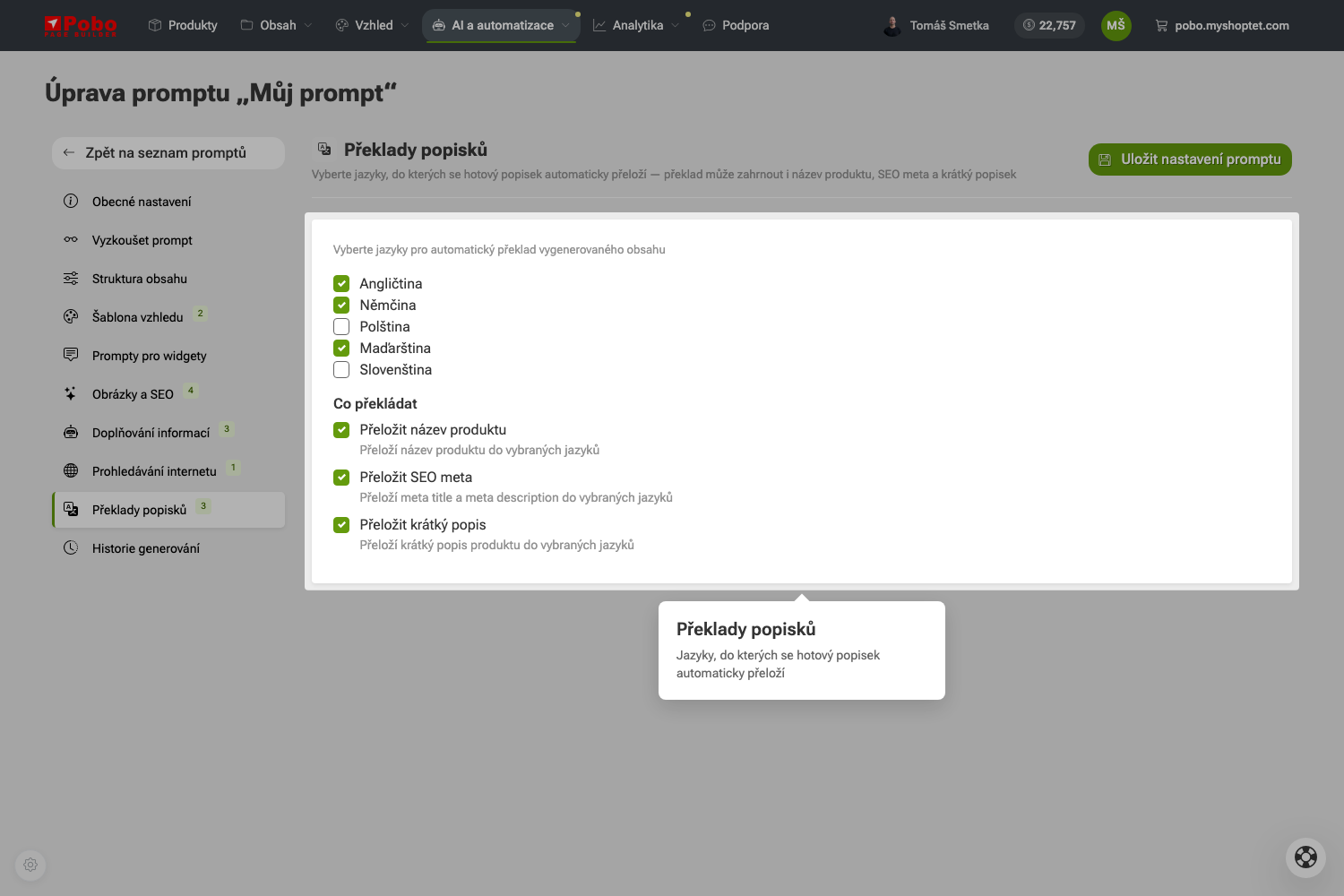 Description translations: languages and what should be translated
 Facts need somewhere to sit
Researched parameters would get lost in one long paragraph. That is why a Pobo description is not made up of text alone, but of widgets, each with its own purpose.
- Parameter tables - this is where the technical data from the research ends up. Brand, model, dimensions, material.
- FAQ - expandable questions and answers. It is also a source for rich snippets.
- Galleries and images - one large image, two side by side, three in a row. AI can even generate missing photos.
- Videos - add your own file or a link.
- Benefits and icons - short points that can be read even when scanning the page.
- Reviews - customer ratings as a separate block.
You can also write your own instruction for each template widget - for example, that the parameters section should contain a table and other sections should use bullet points. The prompt guide describes this in detail.
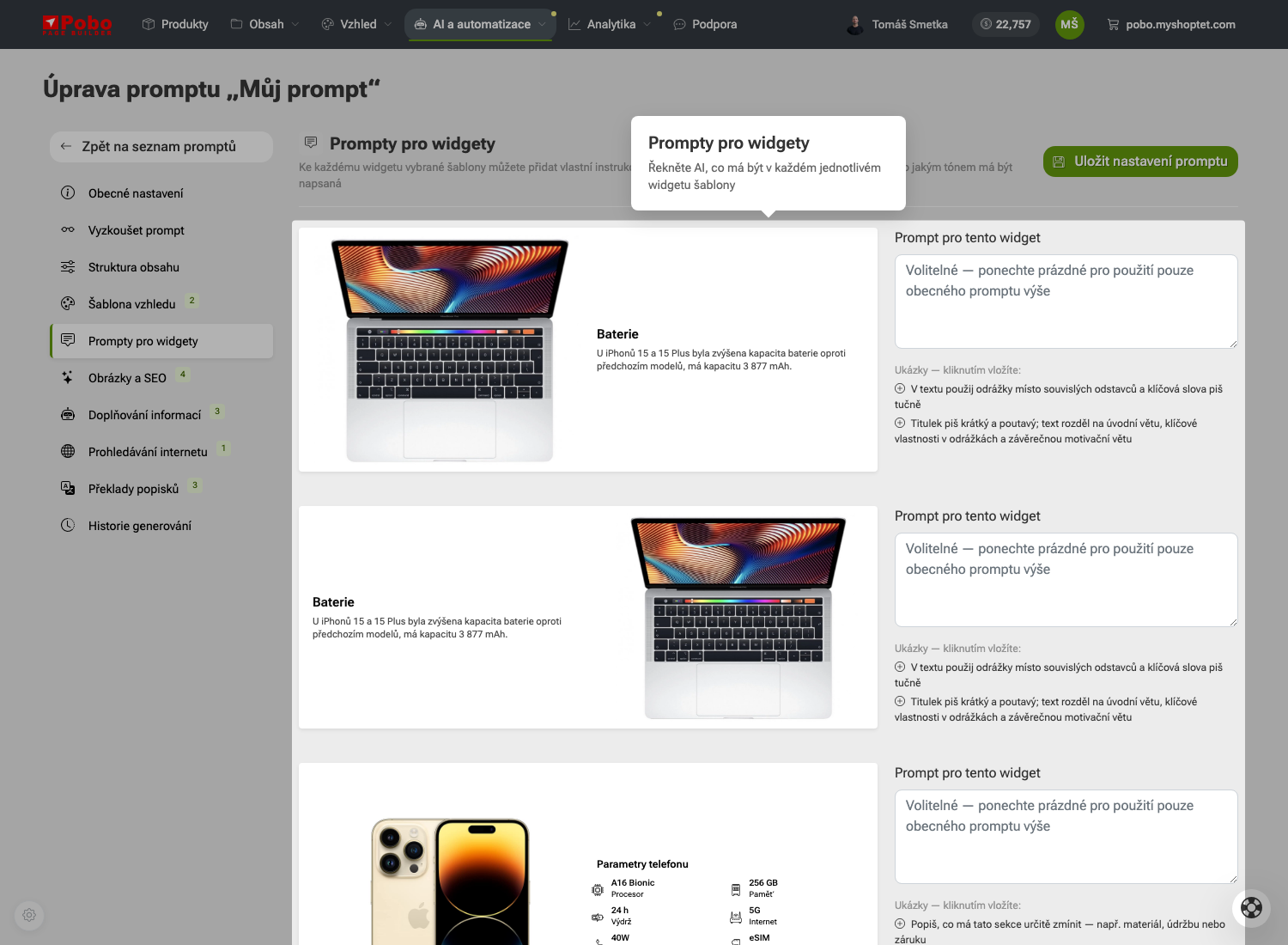 Custom instructions for each template widget
 How to find out whether it really works
Analytics: what people do with the description
There is no point judging a new description by whether you like it. Pobo analytics measures visitor behaviour directly in the content you created.
- Reading depth - how far people scroll and in which part of the description carts were created.
- Widget interactions - the number of uses per hundred views. For FAQs, the figure may exceed one hundred because one person can expand several questions.
- Most frequent FAQ questions - which questions interest people most. A good basis for deciding what to add to future descriptions.
- Comparison with other e-shops - a benchmark to show whether your figure is good or typical.
One important caveat: these figures are descriptive, not causal. They say what happened, not that the description caused it. Someone who scrolled further was probably more ready to buy to begin with. The question “did the text help?” can only be answered by the next tool.
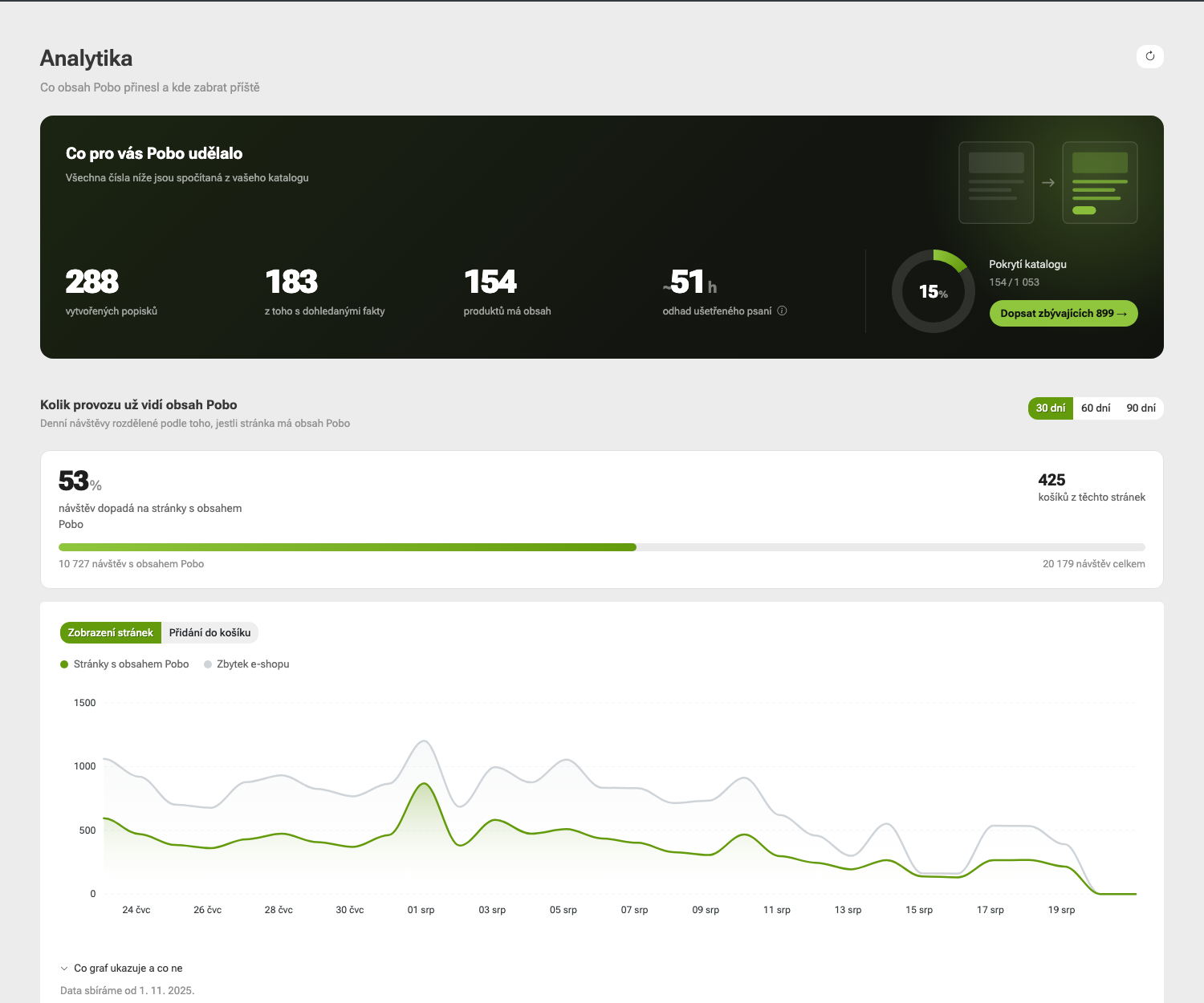 Overview: how many descriptions were created and how many are based on researched facts
 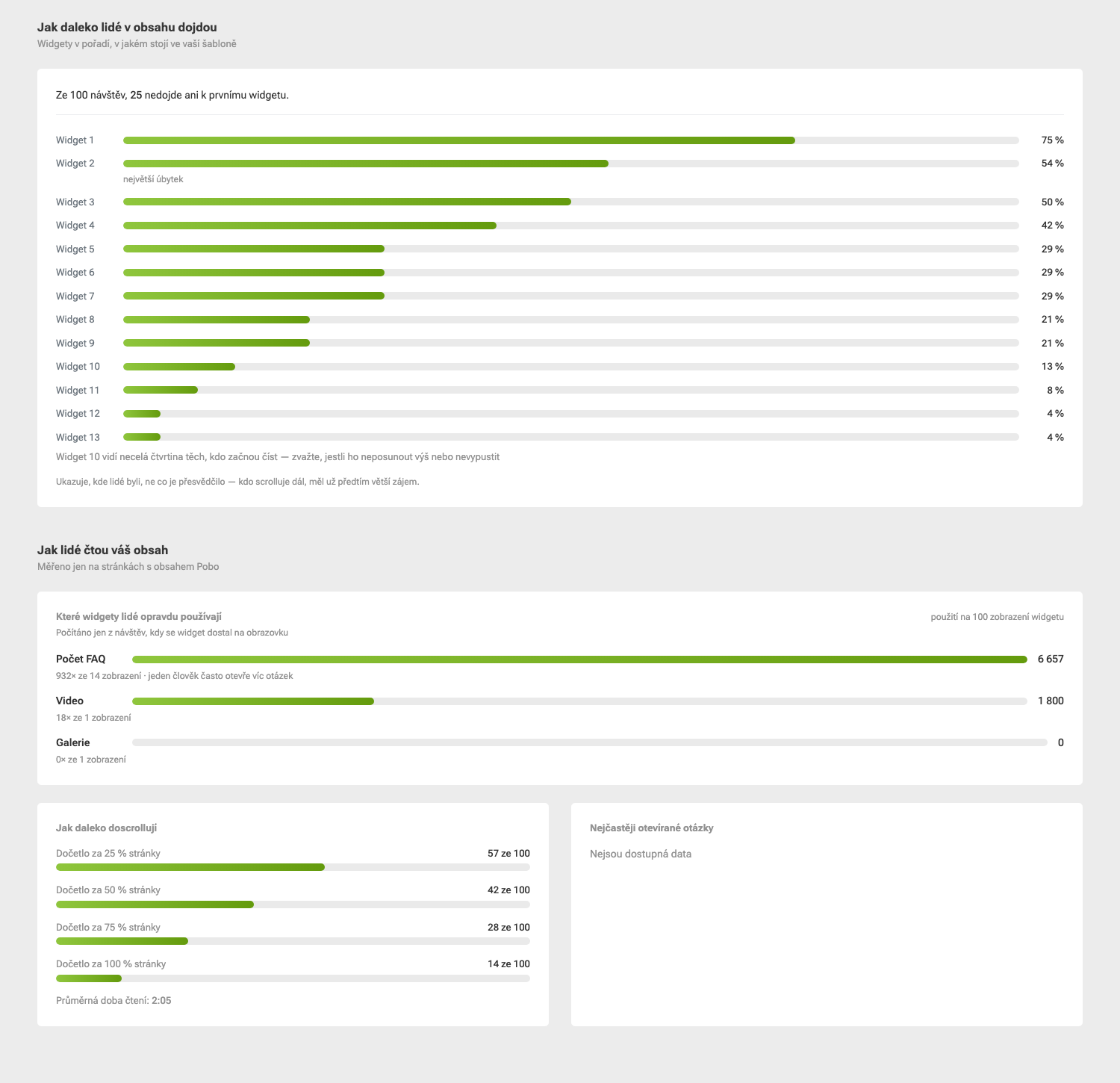 How far people get through the content and which widgets they actually use
 Where to focus next
Analytics shows not only numbers, but also a specific list of products worth working on next. There are four categories:
- Missing description - products people visit but that have no description. They are sorted from the most visited, so the first five rows will have the greatest impact.
- Below average - a description exists, but its results are worse than the rest of the catalogue.
- Recently launched - what is new and worth monitoring.
- Biggest movement - where the results have changed the most.
Each row includes a direct link to the editor, so it is one click from the number to taking action.
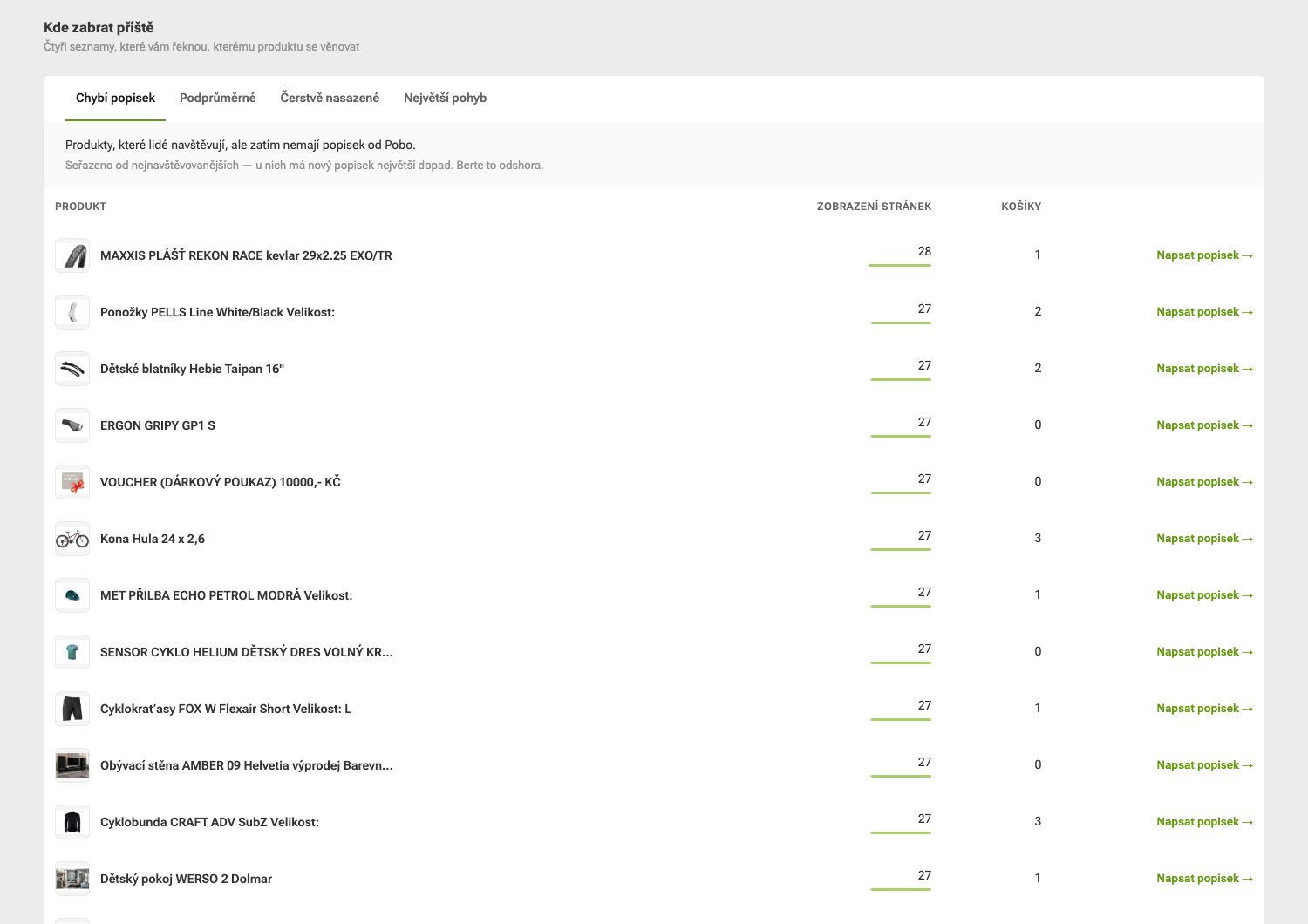 Where to focus next: visited products that do not have a description
 A/B tests: when you want to know whether it helped
An A/B test is the only way to move from a descriptive figure to an answer. Some visitors see one variant, while others see the second, and the difference between them can then be attributed to the content.
In Pobo, you can set up two types of test:
- Original description versus Pobo - compare your original e-shop description with the one you created in Pobo. It answers the question of whether the entire effort was worthwhile.
- Two Pobo content variants - create a second version of the description and find out which one sells better. Suitable for fine-tuning the tone, order of sections or text length.
A test can run across multiple products at once and can be scheduled, paused or ended. A/B tests are currently being rolled out gradually. If you cannot see them in your account yet, contact us to request access.
Recommended settings by product range
You do not need to turn everything on. Depending on what you sell, different settings will be worthwhile:
- Technology, electronics, tools - parameters must be accurate to the decimal place. Enable OpenAI for the EAN and add the manufacturer's website to Internet crawling.
- Cosmetics and food supplements - the key information is the ingredients and how to use the product. Perplexity with source citations makes sense because the information is often outside the manufacturer's catalogue.
- Fashion and home accessories - fewer hard parameters, more information about use. A lighter research process is enough, with more emphasis on Google context and the e-shop AI profile.
- Own production - there is no information about the product on the web, so there is nowhere to search. Feel free to turn research off and instead describe the product thoroughly in the prompt, and above all provide high-quality input data for the product.
Whatever you choose, it is worth testing the new settings on one product first. Prompt testing does not save anything and does not cost credits.
Summary
A Pobo description does not start with the model, but with the product. First, it uses what you already have about it in your e-shop; then it researches the facts on the web and compares them across several independent sources. Anything the sources disagree on is marked as uncertain. Only then is the text written and laid out in widgets that both customers and search engines understand.
You do not have to guess whether it works for you. Analytics shows what visitors do, and an A/B test tells you whether the content is responsible.
If you are unsure how to configure it or research is not returning what you expect for a particular product range, write to us at podpora@pobo.cz. We will be happy to look at a specific product.

Thinking about Pobo? Let us show it to you.
Book a 30-minute call with Lenka. She will show you how Pobo works, what it is good for and how much writing it takes off your hands.
Book a call